
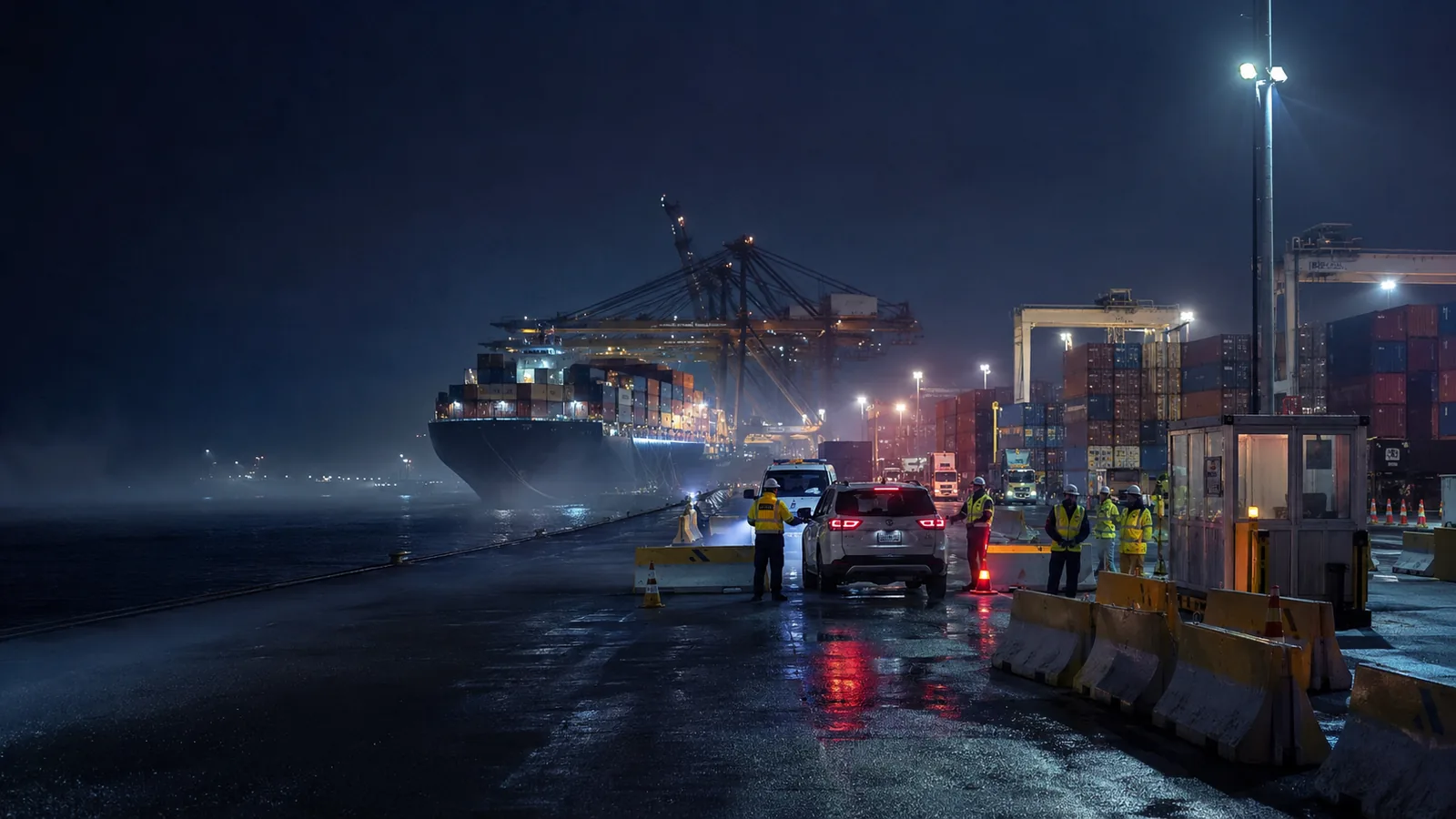
A port can be prepared to intensify security at Level 2 and still be structurally unprepared for Level 3. Level 3 does not always close a facility, but it can change the authorised operating state itself—what may move, what must stop, and which routes and zones must remain available.
Under the ISPS framework, Level 2 applies during heightened risk and requires additional protective measures. Level 3 is exceptional and time-limited, applying when an incident is probable or imminent and requiring further specific measures. Part A also requires port facilities at Level 3 to implement relevant instructions from the Contracting Government.
IMO also makes a point that materially changes readiness planning: security levels may move directly from Level 1 to Level 3. Level 2 cannot therefore be treated as a guaranteed staging period before Level 3.
"Security levels may move directly from Level 1 to Level 3. Level 2 cannot be treated as a guaranteed staging period before Level 3."
1. What actually changes from Security Level 2 to Security Level 3?
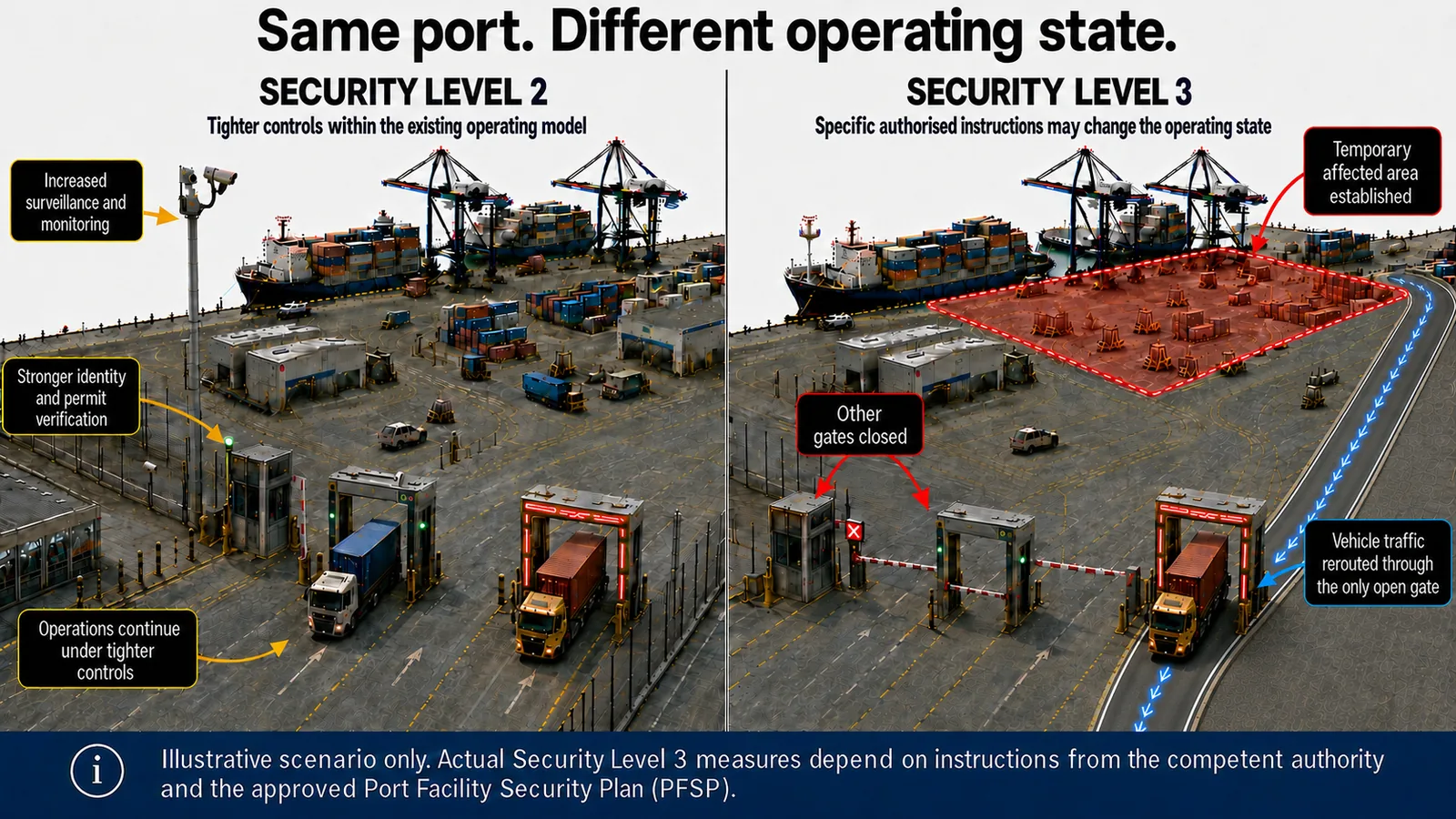
The clearest way to see the difference is not by counting cameras, guards or barriers. It is to examine what happens to the operating rule around six core control points. Level 2 generally strengthens controls within the existing operating model. Level 3 may require an authorised activity, route, gate, zone or movement to be restricted, suspended, redirected or preserved for response.
| Operational breakpoint | Security Level 2 | Security Level 3 |
|---|---|---|
| Access points | Verification and searches intensify; the PFSP may call for fewer access points, additional personnel or stronger barriers. | Access to all or part of the facility may be suspended, or limited to those responding to the incident or threat. |
| People and vehicle movement | Movement continues under tighter verification, search and control. | Pedestrian or vehicle movement may be suspended within all or part of the facility. |
| Restricted areas | Existing restricted areas receive stronger access control, surveillance and patrols. | Additional restricted areas may be established near the incident or believed threat location. |
| Cargo and operations | Cargo, documentation, seal and vehicle checks may be intensified. | Cargo movement or operations may be restricted or suspended within all or part of the facility. |
| Surveillance and lighting | Coverage and intensity of lighting, surveillance and patrols may increase. | Part B contemplates switching on all lighting within, or illuminating the vicinity of, the facility; activating recording-capable surveillance; and maximising recording duration. |
| Command and implementation | The port facility implements the additional Level-2 measures specified in the approved PFSP. | The port facility implements further specific PFSP measures and relevant instructions issued by the Contracting Government or responding authority. |
2. Level 3 adds a command-and-execution problem
Equipment-centric readiness checks often miss the structural difference. At Level 2, the facility implements additional measures specified in its PFSP. At Level 3, it implements further specific measures and relevant instructions from the competent authority and incident responders.
Consider an illustrative case in which an authorised instruction requires a berth-side area to be isolated while an emergency route remains available. That single decision can create a control cascade:
- Boundary and identity: a temporary restricted area changes who may enter, which movements stop and which credentials remain valid.
- Re-routing: one gate or internal route may close while another becomes the controlled response route.
- Surveillance: camera priorities, recording posture, lighting and patrol focus may change around the area.
- Coordination and accountability: the PFSO, ship-side personnel, responders, field teams and command room must share one state and one record of actions and exceptions.
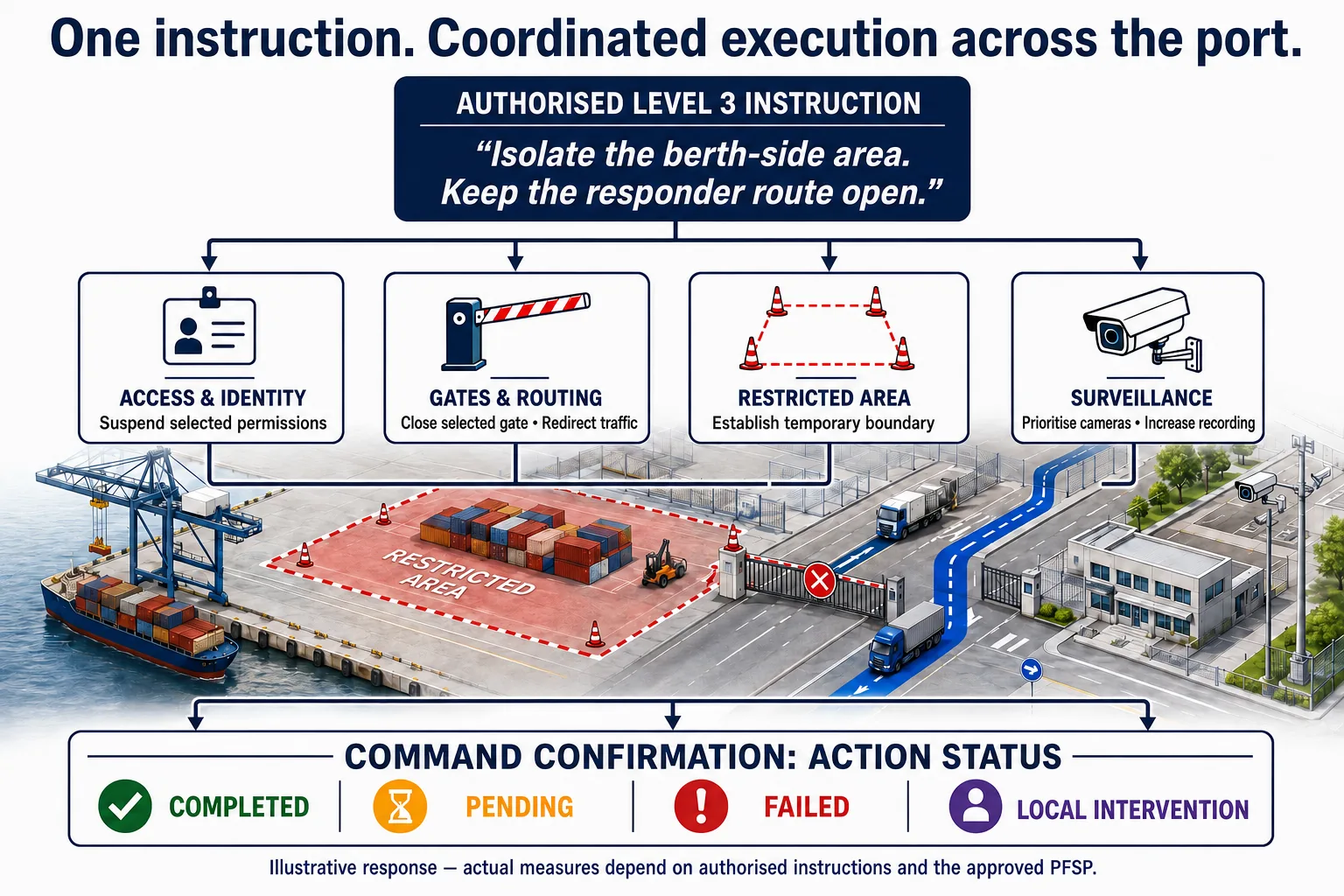
The issue is not whether each control system works independently, but whether one authorised decision can be implemented consistently across the complete control chain.
3. The same systems have a different job at Level 2 and Level 3
Level 3 readiness does not necessarily require a separate technology stack. The same systems can support both levels—but only if their rules, interfaces, capacity and command relationships are designed to change with the authorised security state.
| Control layer | Security Level 2 — architecture role | Security Level 3 — architecture role |
|---|---|---|
| Permit and identity Enabling layer: HEP · Access Control |
Apply tighter validation of people, vehicles and permit conditions consistently. | Restrict, suspend or preserve selected permissions according to the authorised response. |
| Gate and vehicle control Enabling layer: ANPR · RFID · UVSS · Gate Automation |
Increase verification, inspection and gate-control discipline. | Close, stop, redirect or preserve selected gates and movements for authorised response. |
| Restricted-zone enforcement Enabling layer: Access Control |
Strengthen existing zone rules, monitoring and exception handling. | Create or enforce a newly sensitive boundary while preserving authorised access elsewhere. |
| Surveillance and perimeter Enabling layer: CCTV · VMS · PIDS |
Increase coverage, patrol frequency, lighting or monitoring intensity. | Change recording and visibility around the incident while correlating perimeter alerts with video. |
| Command and coordination Enabling layer: ICCC |
Monitor consistent execution of additional PFSP measures across systems. | Coordinate one authorised incident state across gates, permissions, surveillance, perimeter and response. |
"The differentiator is not ‘more devices at Level 3.’ It is whether the same control environment can move from tighter rules to a different authorised state without operators reconstructing that state manually, system by system."
4. The brownfield failure mode is state divergence
Many brownfield ports combine legacy and newer technologies with different interfaces and control assumptions. During escalation, hidden gaps can surface as state divergence: different systems reflect different versions of the authorised response.
A closed gate may still appear valid in the permit platform; a credential may open an isolated area; or a PIDS alarm may not prioritise the relevant VMS camera. The devices work, but they do not share the same state.
The failure is architectural, not necessarily a failed device: the port lacks one current control state.
Brownfield readiness should therefore begin with an integration-readiness assessment, not a blanket-replacement assumption. It should identify what can be retained or integrated, where local intervention or fallback is unavoidable, and what genuinely requires upgrading.
5. Surveillance is a practical stress test of whether the architecture is real
ISPS Part B makes its surveillance guidance unusually concrete. Level 2 may increase lighting, surveillance coverage and patrol frequency. At Level 3, the guidance contemplates switching on all lighting within—or illuminating the vicinity of—the facility, activating recording-capable surveillance equipment and maximising recording duration.
Those measures turn “we have CCTV” into harder engineering questions:
- Can recording settings be changed centrally, and can the VMS, network and storage support longer or more intensive recording?
- Can a perimeter alert automatically bring the relevant camera feed and affected area to the operator’s attention?
- Can monitoring continue during bad weather, network failure or power disruption, and is a manual fallback procedure available?
- Can footage from different cameras and systems be retrieved with consistent timestamps for investigation or review?
These are engineering implications, not additional ISPS clauses. They show why CCTV, VMS, PIDS and the command layer must be tested as one operating chain.
6. Level 3 is not automatically a blanket shutdown
Level 3 is not synonymous with “lockdown.” Part B contemplates measures applying to all or part of a facility: access may be suspended, restricted areas established near the incident, and cargo movement or operations restricted or suspended.
Where the PFSP and authority instructions permit, the port may isolate one area, close one gate while preserving a responder route, or stop one movement category while allowing another. Where full suspension is instructed, the architecture must implement it without ambiguity.
"The strongest Level-3 architecture is not the one that can stop everything fastest. It is the one that can implement the authorised scope accurately—full suspension when required, selective restriction or continuity when that is the approved response."
7. Operational efficiency changes meaning: from throughput to time-to-controlled-state
ISPS Part A 14.1 requires port-facility security measures and procedures to be applied with minimum interference or delay to passengers, ships, personnel, visitors, goods and services. That principle does not mean normal throughput must be protected during a serious threat. Necessary and authorised security action takes priority.
The more useful executive question at Level 3 is not “How many trucks per hour are still moving?” It is: “How quickly can the port reach the authorised controlled state without losing command clarity?”
Speed
How quickly does an authorised restriction, closure, permission change or surveillance posture become effective at every relevant control point?
Precision
Where selective action is permitted, can the port target the affected zone, movement or process without disrupting activities outside the authorised scope?
Coherence
Do gate, access, surveillance, perimeter, command and field teams see the same state and the same record of what changed?
Confirmation
Can the command layer distinguish completed actions from pending steps, failed changes and controls requiring local intervention?
An integrated environment enables efficiency differently at the two levels. At Level 2, it reduces repetition, inconsistency and delay while additional measures are applied. At Level 3, it reduces the time and coordination needed to reach the authorised state without extending disruption beyond the approved response.
8. How end-to-end integration creates one accountable architecture
Security Level 3 is the real test of whether a port’s technologies operate as individual systems or as one connected control environment. When an authorised instruction changes the status of a gate, route, restricted area, credential or cargo movement, the corresponding controls may need to change across the port within a defined and tested response time.
If each system must be updated separately—through different consoles, phone calls or manual instructions—the port risks delay, conflicting actions and uncertainty about whether the required security state has been implemented completely.
An end-to-end architecture built across hardware, software and complete system integration addresses this through three connected layers:
Hardware Layer
Gates, barriers, biometric and RFID readers, ANPR and UVSS equipment, cameras, perimeter sensors, scanners and other field devices must respond according to the same authorised operating state—not as isolated installations.
Software Layer
Existing, new and third-party platforms—permit management, access control, gate automation, VMS, alarm management and incident-response applications—must exchange relevant information and apply consistent rules. Existing systems need not always be replaced if they can be securely integrated.
Integration & Command Layer
The hardware and software layers connect through a common command environment that translates an authorised Level 3 instruction into coordinated actions, provides a shared operational picture and shows which actions are completed, pending, unsuccessful or require local intervention.
This does not mean removing human authority or automatically placing the entire port under lockdown. The competent authority, approved PFSP and designated decision-makers still determine what must change. Integration ensures that once the decision is authorised, the relevant controls can implement it coherently across the port.
The practical Level 3 test: can the port move its connected systems into the authorised operating state through one coordinated command environment—or must every device, platform and operational team still be instructed and verified separately?
From ISPS compliance to an escalation-ready port architecture
The conclusion is clear: Security Level 3 is not an extended version of Security Level 2. Level 2 primarily strengthens protective measures within the existing operating environment. Level 3 may require the port facility to move into a different authorised operating state—changing permissions, access points, routes, restricted areas, surveillance priorities and the activities that may continue.
Level 3 readiness therefore depends on more than the availability of individual security systems. It requires hardware, software, operational workflows and command decisions to function as one accountable control environment. Whether the response requires full suspension or selective restriction, every affected control point must reflect the same authorised state, while emergency access and permitted operations remain protected. At this level, operational efficiency means implementing the required security measures quickly and precisely, confirming their execution and avoiding disruption beyond the approved scope.
Maritime Systems & Integration (MSBU), built on Mantra Softech’s 10 million+ hours of expertise across critical infrastructure, brings this architecture together as an OEM and system integrator. By connecting hardware, software, existing and third-party technologies, commissioning and lifecycle support through its ISPS-compliant port security, harbour-entry, access-management and command solutions, MSBU enables ports to strengthen controls consistently at Level 2 and transition coherently into the authorised Level 3 state.
"Escalation readiness is not measured by how many additional controls a port can activate. It is measured by whether the entire port-facility control environment can respond as one when the authorised operating condition changes."