
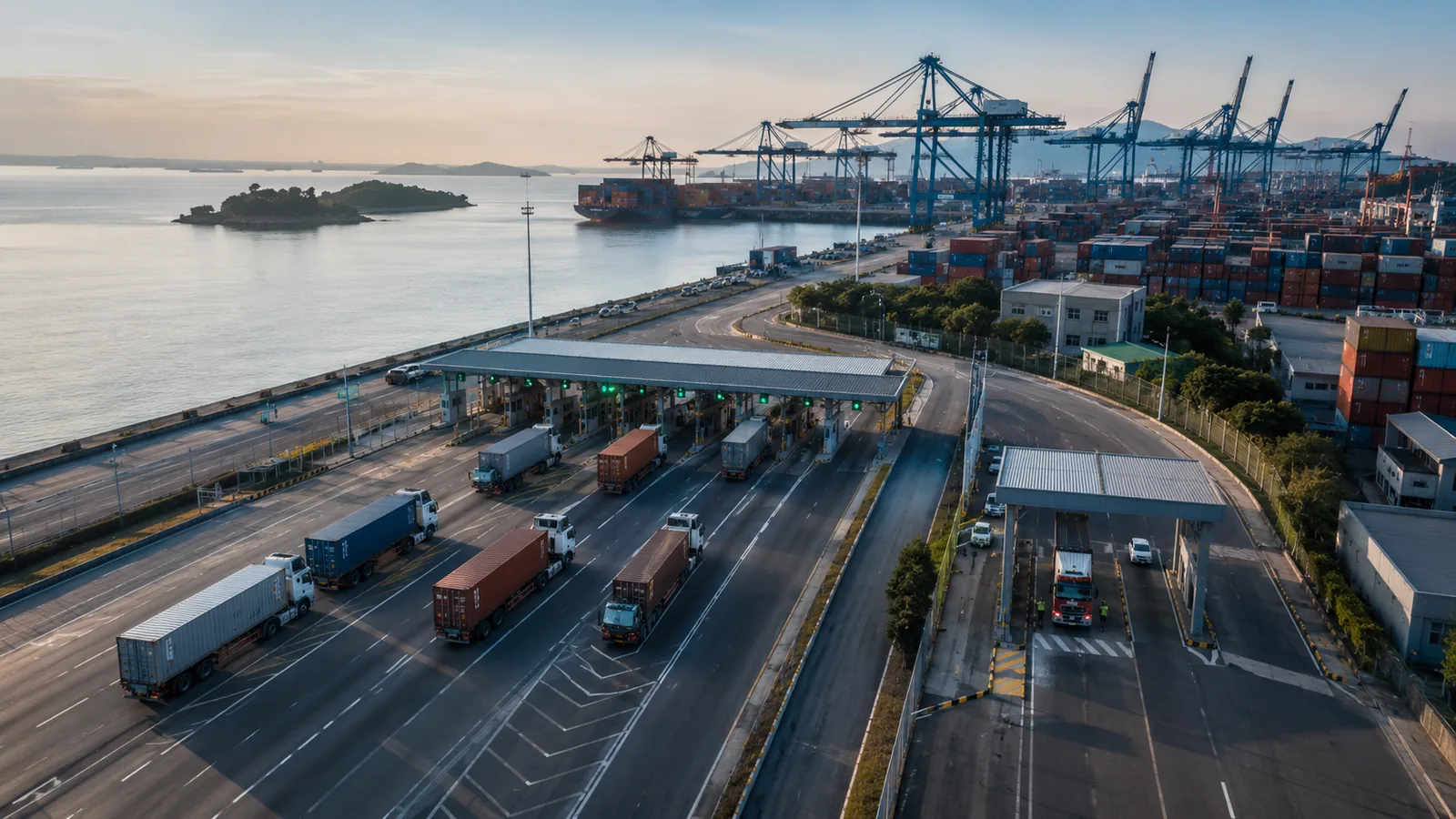
When a port applies rigorous ISPS-compliant controls across permits, vehicles, personnel, inspections and access points, how does it maintain minimum acceptable levels of operational efficiency without allowing those controls to create unnecessary delay?
A truck reaches a port gate with an approved entry permit, an identified driver and a legitimate operational purpose. Yet the movement can still stop while one team reconfirms the permit, another validates the vehicle, an inspection record is checked separately, and an exception is escalated through calls or manual intervention.
Every control may have a valid security purpose. The more important question is whether the delay is created by the security requirement itself, or by the way information, systems and decisions are connected. In a high-throughput port, that distinction separates necessary security time from avoidable operational friction.
"The question is not whether a control is justified. It is whether the delay comes from the security requirement itself—or from rediscovering information that already exists."
1. ISPS does not equate stronger control with more delay
The ISPS Code is fundamentally risk-based. IMO describes ship and port facility security as a risk-management activity in which appropriate measures follow an assessment of the risk in each particular case. The framework therefore supports adequate and proportionate protection as security conditions change, rather than maximum intervention as the default operating model.
The efficiency point is equally important. ISPS Code Part A, section 14.1 requires port facility security measures and procedures to cause a minimum of interference with, or delay to, passengers, ships, personnel, visitors, goods and services. India’s 2024 Merchant Shipping (Ships and Port Facility Security) Rules repeat the same operational requirement for port facilities.
For port leadership, this creates a second management question beyond compliance: once the required controls are in place, are they producing the intended security outcome without introducing avoidable operational friction?
2. Necessary security time and design-created delay are not the same thing
Some delay is the direct consequence of security. A suspicious vehicle may need secondary inspection, a restricted area may require additional identity verification, and a security incident can justify stopping movement altogether. Removing those interventions would weaken the control.
Other delays appear because the port has to rediscover information that already exists, reconcile systems that do not share a common state, or send routine movements through the same manual path as exceptions.
| Necessary security intervention | Avoidable operational friction |
|---|---|
| Secondary inspection when risk or procedure requires it | Repeating a check because verified status is unavailable downstream |
| Restricting access to a protected area | Waiting while separate systems re-establish the same authorisation |
| Holding a movement after an anomaly is detected | Holding normal movements because routine and exception flows are processed identically |
| Increasing scrutiny when the security condition changes | Applying high-friction controls continuously because the process cannot adapt |
| Human review of an ambiguous event | Human intervention in every transaction because routine clearance cannot be established |
If additional time results from a control required by the approved plan, assessed risk or a genuine security exception, that time may be justified. If it is spent rediscovering information already verified elsewhere, the delay points to an operating-design problem.
3. Where unnecessary friction enters the security chain
Operational delay rarely comes from one system alone. It accumulates at the handoffs between authorisation, identity, inspection, enforcement and response. Four breakpoints matter particularly in a live port environment:
- Approval exists, but enforcement cannot consume it. A harbour entry permit may be authorised before arrival, yet the gate still has to re-establish the status before acting.
- Identity is known, but not trusted across systems. Vehicle identity, personnel credentials and access rights can sit in different platforms, forcing teams to revalidate the same movement.
- Routine movements and exceptions follow the same path. Normal traffic then inherits the processing burden intended for uncertain cases, especially when several systems require manual interpretation.
- Detection exists, but decision context does not. ANPR, UVSS, access control and surveillance can each produce useful outputs, while operators still have to assemble those outputs before deciding to allow, hold or respond.
The issue therefore sits in the handoff between one valid security decision and the next, not simply in the speed of an individual device or gate.
4. Let the authorised state move with the transaction
IMO’s broader facilitation work provides a useful parallel. Maritime Single Window requirements are designed around coordinated electronic submission and reuse of information, while the IMO Strategy on Maritime Digitalization approved by FAL 50 in March 2026 emphasises interoperability, system standardisation, data-sharing and effective data governance. These are not ISPS security requirements, but they reinforce a wider maritime operating direction: information should remain usable across system and organisational boundaries instead of being repeatedly recreated.
World Bank work on Port Community Systems reaches a similar conclusion from the logistics side, linking weak information sharing with delayed decision-making and inefficient planning. Applied carefully to port security, the design question becomes simple: can a security status already established upstream become usable at the next control point?
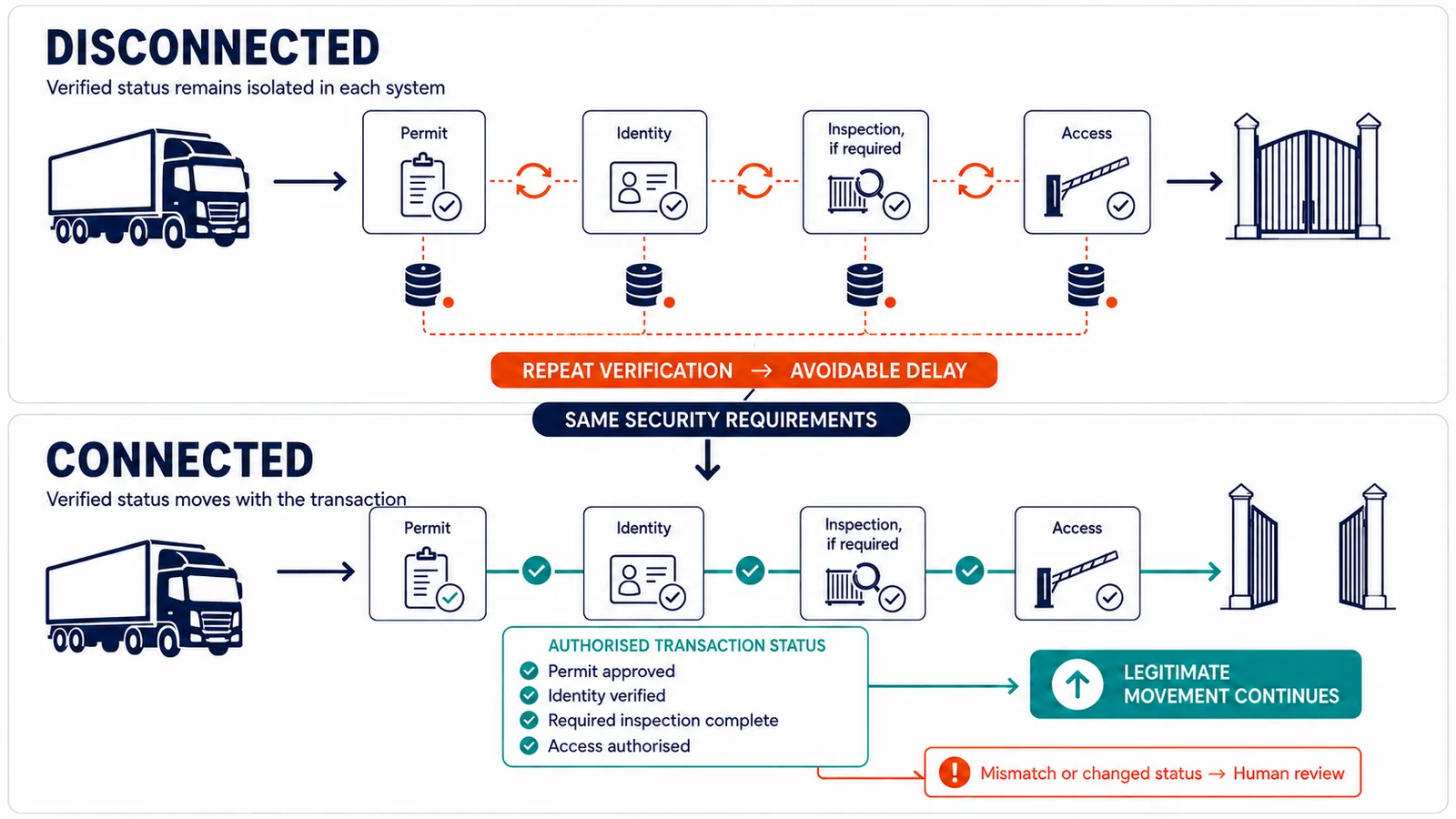
For a legitimate vehicle movement, the practical difference becomes clearer when each friction point is paired with the connected response that should follow it:
| Where operational friction appears | Integrated response |
|---|---|
| Permit approved, but the gate cannot use the same authorised status. Repeat verification begins when the vehicle arrives. | Harbour Entry Permit + ANPR/RFID can connect the pre-approved movement with the arriving vehicle, reducing repeated gate-level verification. |
| Vehicle identity and access permission sit in separate systems. Staff still have to confirm whether the arriving vehicle is authorised. | ANPR + Access Control can connect recognised vehicle identity with the current authorised access state. |
| Inspection is completed, but its status remains isolated. Another team has to reconfirm whether the required check was completed. | UVSS + security systems can share inspection status within the same movement context where inspection is required. |
| The movement is cleared, but physical gate action still requires manual coordination between access decisions and gate equipment. | Access Control + Gate Automation can translate the authorised state into the required physical gate action. |
| An exception occurs, but permit, access, inspection and surveillance context must be assembled from separate systems. | ICCC can correlate permit, identity, access, inspection and surveillance context so operators focus on the exception with the information needed to decide. |
| All technologies exist, but they remain disconnected. Different hardware, software and vendor environments leave teams transferring or reconciling information manually. | End-to-end system integration connects hardware, software, existing infrastructure, new technologies and third-party systems so verified information can move across the control chain instead of stopping at system boundaries. |
A port can therefore own every required technology and still experience avoidable delay. The efficiency gain appears when verified information can move with the authorised transaction, while each system continues to perform its own security function. Integration does not remove a risk-driven inspection, secondary check or security hold; it reduces the additional wait created by manual handoffs, duplicate verification and disconnected records.
5. From individual security controls to one integrated operating architecture
The previous breakpoints lead to a broader architectural conclusion: having all the relevant security technologies in place does not necessarily create an integrated security environment.
An approval may exist in one application, vehicle identity in another and inspection status somewhere else, while the physical gate depends on a separate system. When those systems cannot exchange the relevant authorised state, people become the integration layer—reconfirming information, transferring status or reconciling records before movement can continue.
The operational difference is therefore not simply between having a security technology and not having it. It is between having multiple functioning controls and enabling those controls to operate as one connected security environment.
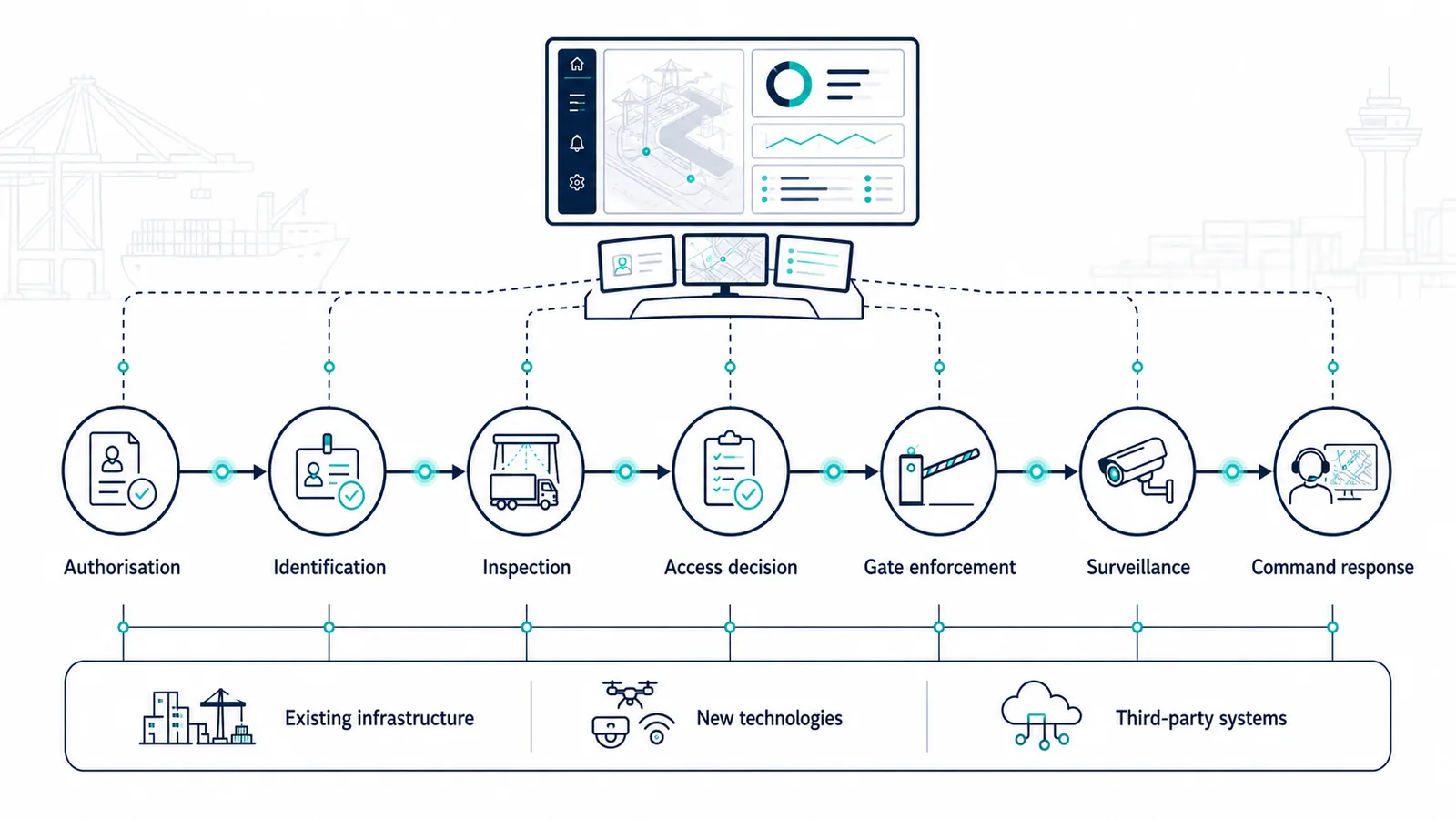
In a connected architecture, each layer performs its own security function while relevant verified information becomes available to the next decision. This does not remove inspections, secondary verification or security holds when they are genuinely required. It reduces the additional friction created when the same operating state has to be rediscovered at every system boundary.
Maritime Systems & Integration (MSBU), built on Mantra Softech’s 10 million+ hours of expertise across critical infrastructure, approaches port security as an end-to-end hardware and software architecture rather than a collection of isolated products. Mantra Softech, as an OEM and system integrator, combines in-house engineering and manufacturing with multi-vendor integration capabilities to connect existing infrastructure, new technologies and third-party systems around the required security and operational outcome. Explore the integration approach.
"The objective is not integration for its own sake. It is to make permit, identity, inspection, access, surveillance and command layers operate from a coordinated security state—while preserving every control the assessed risk and approved plan require."
6. What should port leadership measure?
Security efficiency becomes easier to improve when the port measures where decisions are being recreated rather than looking only at total gate time. Four diagnostic indicators can expose avoidable friction without treating them as ISPS compliance metrics:
Repeat-Verification Rate
How often does an already authorised person or vehicle require the same status to be manually established again downstream?
Manual Handoffs Per Movement
How many times must staff transfer, compare or re-enter status between systems before a normal movement can continue?
Decision-to-Enforcement Time
Once an authorised state is established, how long does it take for the relevant access point or gate to act on that decision?
Exception Ratio and Cause
What share of routine movements require human intervention, and how much comes from genuine security exceptions rather than missing or inconsistent system information?
These measures do not replace the Port Facility Security Assessment, the approved Port Facility Security Plan or statutory security controls. They help leadership identify where the operating design is consuming time without creating a new security decision.
7. Efficiency must survive a change in security condition
A port architecture is not genuinely efficient if it works only under routine conditions. ISPS Part A requires additional protective measures at Security Level 2 and further specific measures at Security Level 3, in line with the approved Port Facility Security Plan and applicable instructions. The same connected architecture should therefore support a controlled change in operating state without forcing teams to reconstruct information flows during escalation.
Routine authorised flow → heightened verification → tighter controls where required → selective restriction → central visibility—without rebuilding the information flow at each step.
The objective is not to minimise controls during escalation. It is to intensify the right controls quickly while preserving movements that remain authorised wherever the approved plan allows them. Efficiency, in this context, means removing avoidable friction around the security decision, not weakening the decision itself.
The bottom line: stronger ISPS controls do not have to slow legitimate operations
ISPS compliance and operational efficiency do not have to work against each other. Additional inspections, verification or restrictions may be necessary when risk or the approved Port Facility Security Plan requires them, but repeated checks, manual reconciliation and disconnected systems create delay without adding new security value.
A port may therefore have every required security technology and still lose time if permit, identity, inspection, access, surveillance and command systems operate separately. The stronger model is one in which each control performs its security function while verified information remains usable across the complete movement.
Operational efficiency is not about reducing security controls. It is about ensuring that tighter security results in additional intervention only where the security requirement demands it, rather than allowing fragmented systems and information handoffs to slow legitimate port operations unnecessarily.
"A port does not become efficient by having fewer controls. It becomes efficient when verified information moves with the authorised transaction, and every control still performs its own security function."