

Ports spend heavily to reduce turnaround time. Yet some delays begin before movement itself — while information is checked, permissions are confirmed and decisions move between systems and teams.
A commercial vehicle may be ready to enter, but authorization is still being verified. An alarm may have triggered, but the operator is still establishing where it occurred and whether it requires action.
Nothing is necessarily broken. Yet the result can still be waiting, repeated verification and operator intervention.
The problem is not simply delay. The control itself may be introducing avoidable operational friction.
At the gate, perimeter and control room, operational efficiency and security are shaped by the same control architecture: how quickly a decision can be made, how reliably it can be enforced, and how clearly it can be evidenced.
"Can a port strengthen its security controls without slowing the operation they are meant to protect?"
Where the Real Difficulty Begins
The ISPS Code provides a risk-based framework for protecting ships and port facilities. The difficult part begins after the requirement has been defined.
A port may have the procedure, hardware, software, people and integration — yet still have a control that is slow to execute, dependent on manual reconciliation or difficult to demonstrate afterwards.
"A security control is only complete when the full chain works."
ISPS requirement → Control logic → Hardware + software → Operational enforcement → Evidence
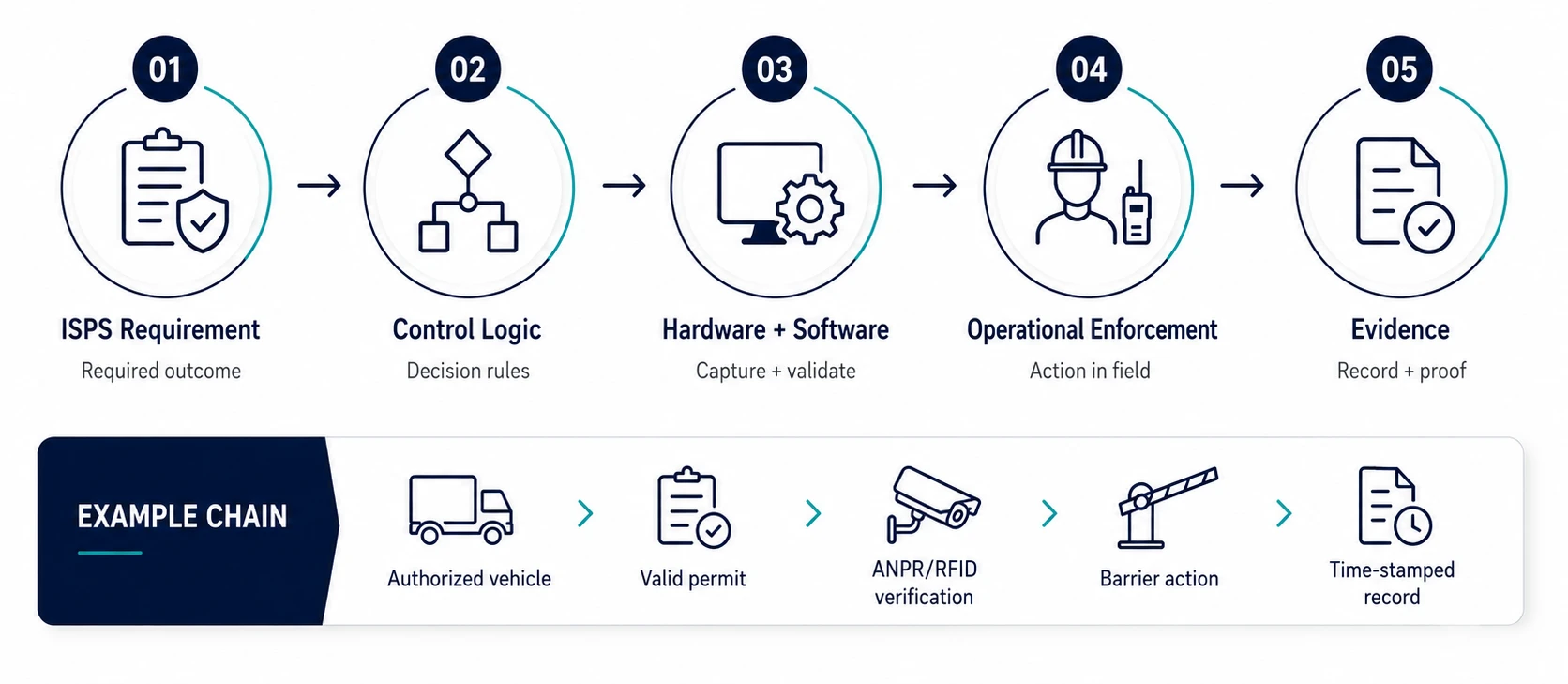
When that chain is weak, the symptom may look like an efficiency, technology, integration or compliance problem. Often, the underlying issue is the same: the control has not been engineered end to end.
Port Security Outcomes Are Engineered, Not Installed
Take access control for example. The decision may depend on identity, purpose of entry, permit validity, vehicle authorization, permitted area and any additional checks required by the approved security process.
The access-control device is only one layer. A camera can provide visibility without context. A perimeter sensor can generate an alarm without making the event understandable. A gate can open automatically while the decision behind it remains manual. An ICCC can consolidate information, but it cannot create context that upstream systems never captured.
"The better question is not whether the system exists. It is what has to be true, at every layer, for the port to answer “Yes” with confidence."
Five Control Chains That Reveal the Real State of ISPS Readiness
The ISPS Code expects port facilities to maintain effective measures across areas such as access control, monitoring, restricted areas, security duties and changing security conditions. The practical question is whether those requirements can be executed as complete operating controls.
The technologies can differ but the test is the same: can the port demonstrate that each control works as one complete operating chain?
| ISPS Control Area | What the Port Should Be Able to Demonstrate | Capability & Solutions Stack |
|---|---|---|
| Identity Management & Physical Access Control | Can the port establish who is requesting access, why access is required, whether the person and associated vehicle are authorized, where access is permitted, and whether required access-control or inspection measures were applied? | HEPS + Access Control + ANPR + RFID |
| Commercial Vehicle Screening & Gate Automation | Before a commercial vehicle is admitted, can the port establish that prior authorization, identification, screening and required inspection conditions were satisfied before the barrier opened? | Gate Automation + HEPS + ANPR + RFID + UVSS |
| Monitoring, Perimeter Security & Restricted Areas | Can the port detect, locate and verify abnormal or unauthorized activity early enough to support an effective response, while understanding the operating limits of the detection technologies being used? | CCTV + VMS + Video Analytics + PIDS |
| Security-Level Change & Operational Enforcement | When the security level changes, can the port demonstrate that the additional measures required by the approved plan were translated into operating KPIs at relevant gates, access points, restricted areas and surveillance functions? | Access Control + Gate Automation + Surveillance + ICCC |
| Incident Response, Reconstruction & Evidence | Can the port reconstruct a security event from detection through verification, response and closure, with a clear record of what happened, who acted and what evidence remains? | ICCC + VMS + Access Logs + Integrated Event Management |
The underlying questions are simple: Who was authorized? Why was entry granted? What was detected? What changed? What can be demonstrated afterwards?
A security measure becomes operational when the port can carry it from requirement to decision, decision to enforcement, and enforcement to evidence.
The Operational Efficiency Problem Is Often Bigger Than Integration
It is tempting to look at every fragmented control and conclude that the answer is integration. That is only partly true.
Sometimes systems need to be connected. But sometimes coverage is inadequate, the field device is wrong for the environment, software lacks the right authorization context, or the workflow itself creates unnecessary intervention.
"Integration cannot repair a poorly designed control."
The starting point should therefore not be “What should we integrate?” but “What should this control achieve, what already works, and what is preventing the outcome today?”
Adopting a Brownfield Approach
Most established ports do not start from a blank sheet. They inherit cameras with useful life remaining, RFID at selected points, legacy access-control devices, standalone applications, manual registers, barriers, sensors and operating practices built over years.
The wrong response is to replace everything. The equally wrong response is to preserve everything simply because it already exists.
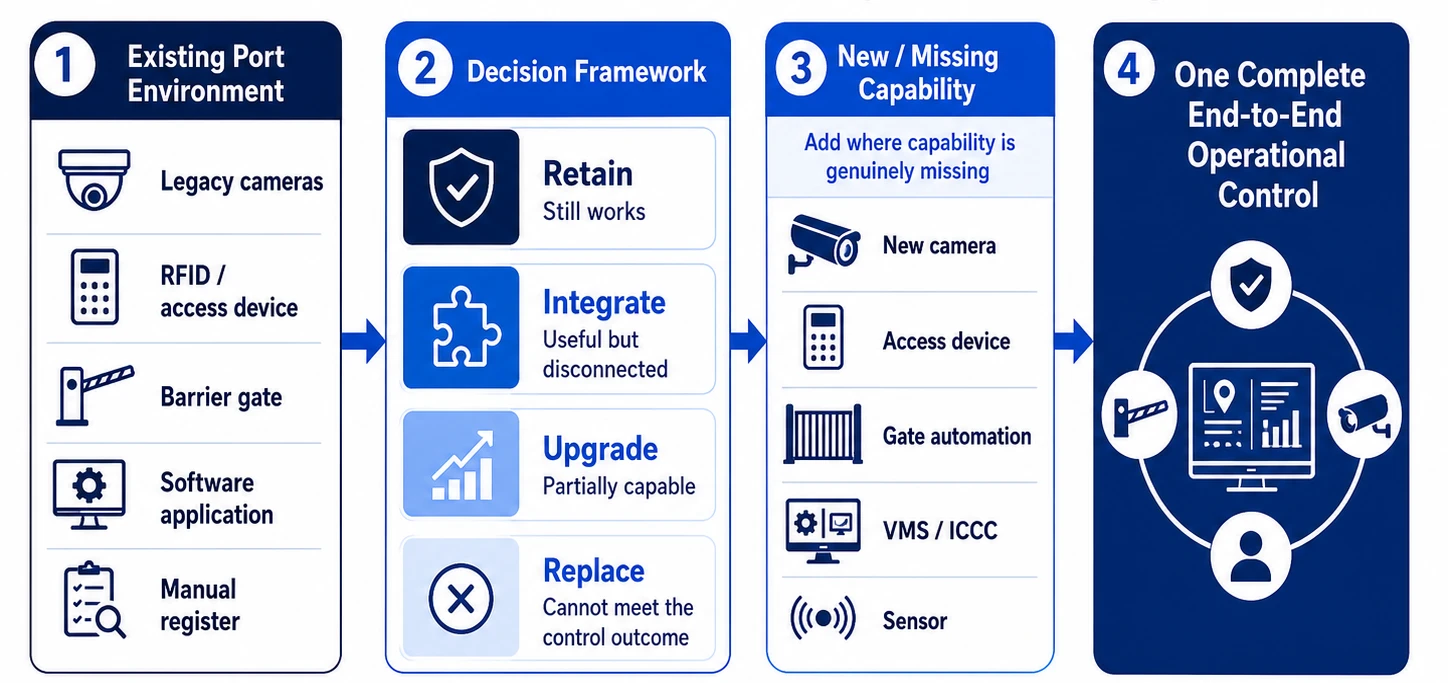
"A Brownfield approach begins with the control, not the product catalogue."
- What should remain?
- What is useful but disconnected?
- Where is capability genuinely missing?
- Which workflow or software logic is creating friction?
- What must connect for the control to work end to end?
A port may need a new camera, a stronger access device, a harbour-entry workflow, a gate-automation layer, a perimeter sensor, a VMS upgrade, an ICCC — or simply a better architecture around what already exists.
The architecture should follow the ISPS security outcome — not the product catalogue.
Assess the control → Retain what works → Add what is missing → Integrate what must connect → Demonstrate the outcome
From Documented Measure to Demonstrable Control
| Maturity Level | What It Means |
|---|---|
| 1. Documented | The security measure is defined in the plan or procedure. |
| 2. Installed | The required hardware, software or operational capability exists. |
| 3. Integrated | The control can use the information and systems it needs to operate as intended. |
| 4. Demonstrable | The port can show how the control worked, who acted and what evidence remains. |
The critical transition empowers a shift from a control that exists to one that can operate as intended — and be demonstrated when required.
Using the IMO Self-Assessment Guidelines
International Maritime Organization (IMO) gives port facilities a structured way to examine current security arrangements and identify areas that may require attention.
Open the official IMO MSC.1/Circ.1192 self-assessment guidance
The purpose of the self-assessment is therefore not only to confirm that a measure exists. It is to expose where the control may be weak in practice — and what needs to change for that control to work more effectively.
"Assessment identifies the weak control. Engineering closes the gap."
From Assessment to Operational Control
Maritime Systems & Integration (MSBU), built on Mantra Softech’s 10 million+ hours of expertise across critical infrastructure, works across this full control chain: understanding the existing port environment, retaining what still works, identifying what is genuinely missing, supplying the required hardware and software, and engineering the architecture around the intended security outcome.
MSBU’s consultative approach aims to reduce avoidable operational friction while strengthening the port’s ability to execute, sustain and demonstrate its security controls.
These capabilities are intended to support security controls and operational outcomes relevant to ISPS implementation. The exact requirement, design and acceptance remain dependent on the port facility’s PFSA, approved PFSP and applicable national requirements.
"The real measure of readiness is assessing and updating the existing control system that can work as one coherent chain — securely, efficiently, and ready for upgrades when it matters."