
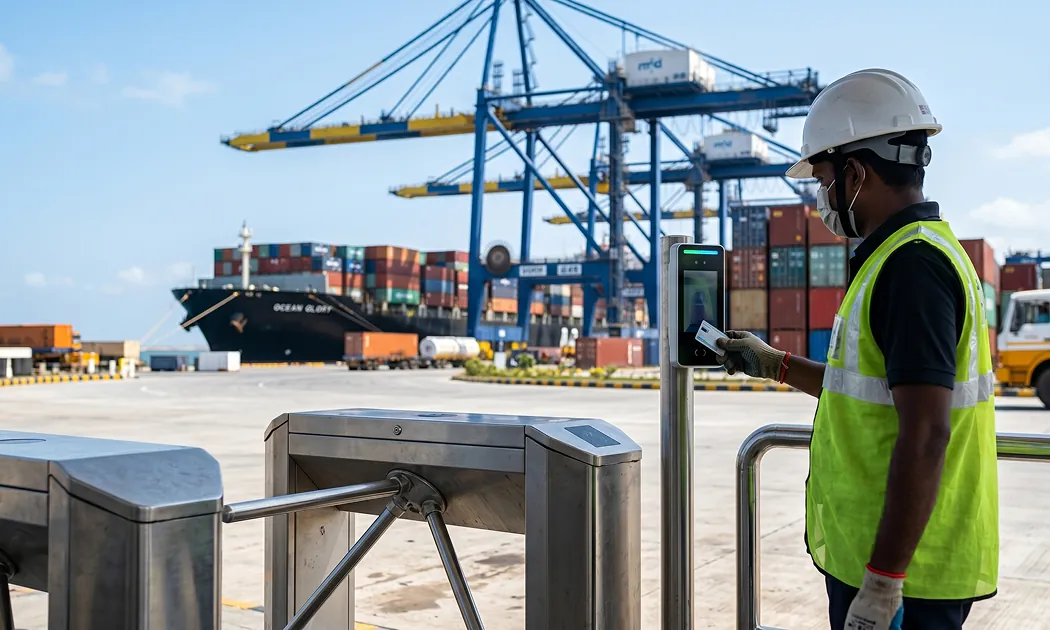
Compliance as a Structural Baseline
While the Maritime Amrit Kaal 2047 vision sets a high bar for system-level transformation, the immediate reality for every port operator begins with a mandatory baseline: the International Ship and Port Facility Security (ISPS) Code.
The ISPS Code functions as the essential regulatory foundation for maritime safety in India, establishing a mandatory framework for identity verification, access control, and incident response. While most Indian port facilities demonstrate strict adherence to these requirements, compliance represents a starting point—not the finish line.
"Standard compliance validates that a security policy exists; however, it does not always account for how these protocols perform under the stress of 24/7, high-volume operations."
Moving from Linear Theory to Operational Reality
Security processes under the ISPS framework are typically designed as a sequential chain:
Verify Identity → Issue Credential → Validate Access → Monitor Activity
In a live port environment, these stages often begin to drift into separate silos:
- Identity verification occurs during the initial onboarding phase but is rarely re-confirmed during the actual work shift.
- Credentials (such as RFID cards or paper permits) are used as a proxy for the person, introducing a risk of unauthorized transfer.
- Access points focus on the validity of the token rather than the real-time status of the individual.
- Surveillance often runs as a separate recording function, used primarily for investigating incidents after they have occurred.
The Credential Paradox: Identity vs. Tokens
In an ISPS-aligned facility, the security credential is the primary tool for movement. However, a credential is only a proxy. In high-pressure maritime environments, relying solely on physical tokens—relying on “what you have” instead of “who you are”—presents specific risks:
Credential Sharing
Cards can be passed between workers to bypass attendance or access rules.
Outdated Permissions
A worker's authorization might change mid-shift, but their physical card remains active.
Manual Overhead
Security staff must manually verify that the person holding the card matches the photo on file.
Managing a Dynamic Workforce
Port operations rely on a massive, non-permanent workforce. Efficient logistics requires a security system that can handle the following capabilities:
- Time-Bound Access: Authorization that automatically activates and expires based on specific work orders.
- Zone-Specific Permissions: Restricting personnel to their assigned areas to prevent safety hazards.
- Real-Time Revocation: Instantly terminating access the moment a contract or shift ends.
"Without a coordinated system, managing these thousands of moving parts depends on manual checks, which are prone to human error and create bottlenecks at the gates."
Reframing the Security Objective
The shift in port management today is moving toward a more proactive stance. The table below compares the current approach with the expert-level benchmark that leading ports are targeting:
| Current Approach | Expert-Level Benchmark |
|---|---|
| Validating Events (Did the gate open?) | Continuous Awareness (Who is currently in the restricted zone?) |
| Log-Based Security (Reviewing data) | Context-Aware Security (Preventing unauthorized entry in real-time) |
| Forensic Monitoring (Post-incident) | Operational Visibility (Active tracking of personnel and assets) |
The Ultimate Takeaway
The ISPS Code provides the necessary foundation for a secure maritime sector. As Indian ports evolve into global logistics leaders under the Sagarmala Programme, the goal is to build on this foundation.
The most efficient ports are those that move away from isolated security checks and toward a unified, identity-linked architecture. But how do you build this in a high-pressure environment without stopping the flow of trade?