
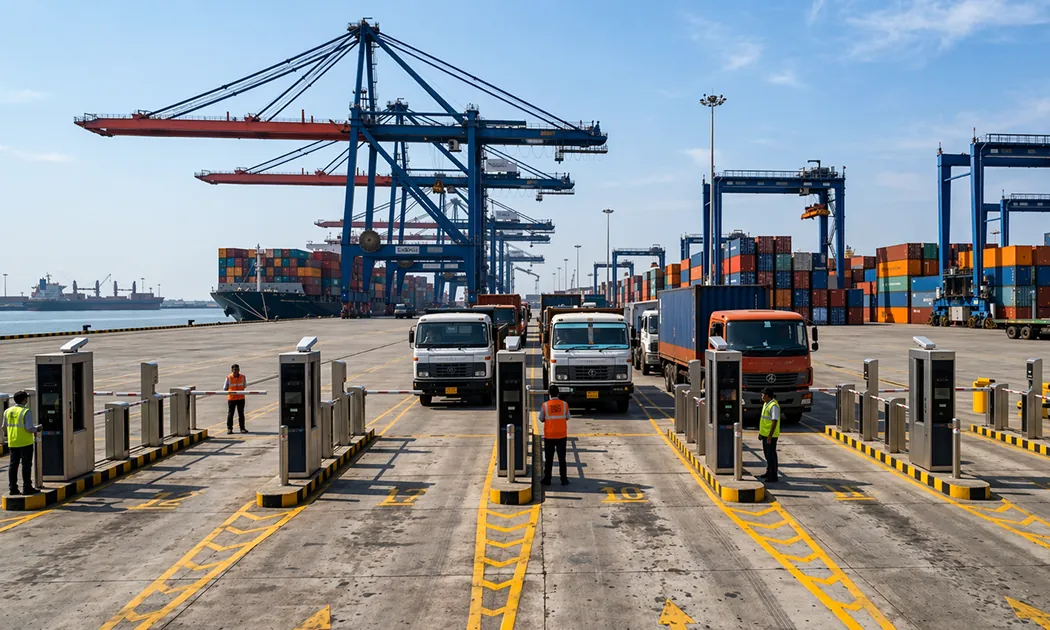
Moving Beyond System Presence to True Synchronization
Port ecosystems are scaling faster than the frameworks built to manage them. As cargo volumes surge and workforce logistics grow more complex, merely installing isolated security hardware is no longer sufficient. Most modern ports operate with disconnected layers—identity verification, access control, and surveillance—that function in silos. They exist in the same facility but fail to speak a shared operational language.
Real-world efficiency depends on structural synchronization. Current setups often achieve "functional completeness," where every system performs its individual task. However, they lack the real-time coordination needed to handle massive cargo volumes, which hit 915.17 million tonnes in FY 2025-26 (Source: PIB India).
Strategic Coordination: The New Operational Standard
Modernization often focuses on "integration"—the basic exchange of data between platforms. While integration is a start, coordination represents a much more advanced model where systems act collectively. Rather than just sharing information, systems work in total harmony to anticipate operational needs before they become problems.
In a coordinated environment:
- Unified Intelligence: Every system operates on a shared understanding of identity and operational context.
- Simultaneous Decisioning: Changes in a worker's status or a security alert reflect instantly across every gate and terminal.
- Active Response: An event detected by a camera triggers an immediate response—such as an access change—without waiting for manual intervention.
The Identity-Centric Framework
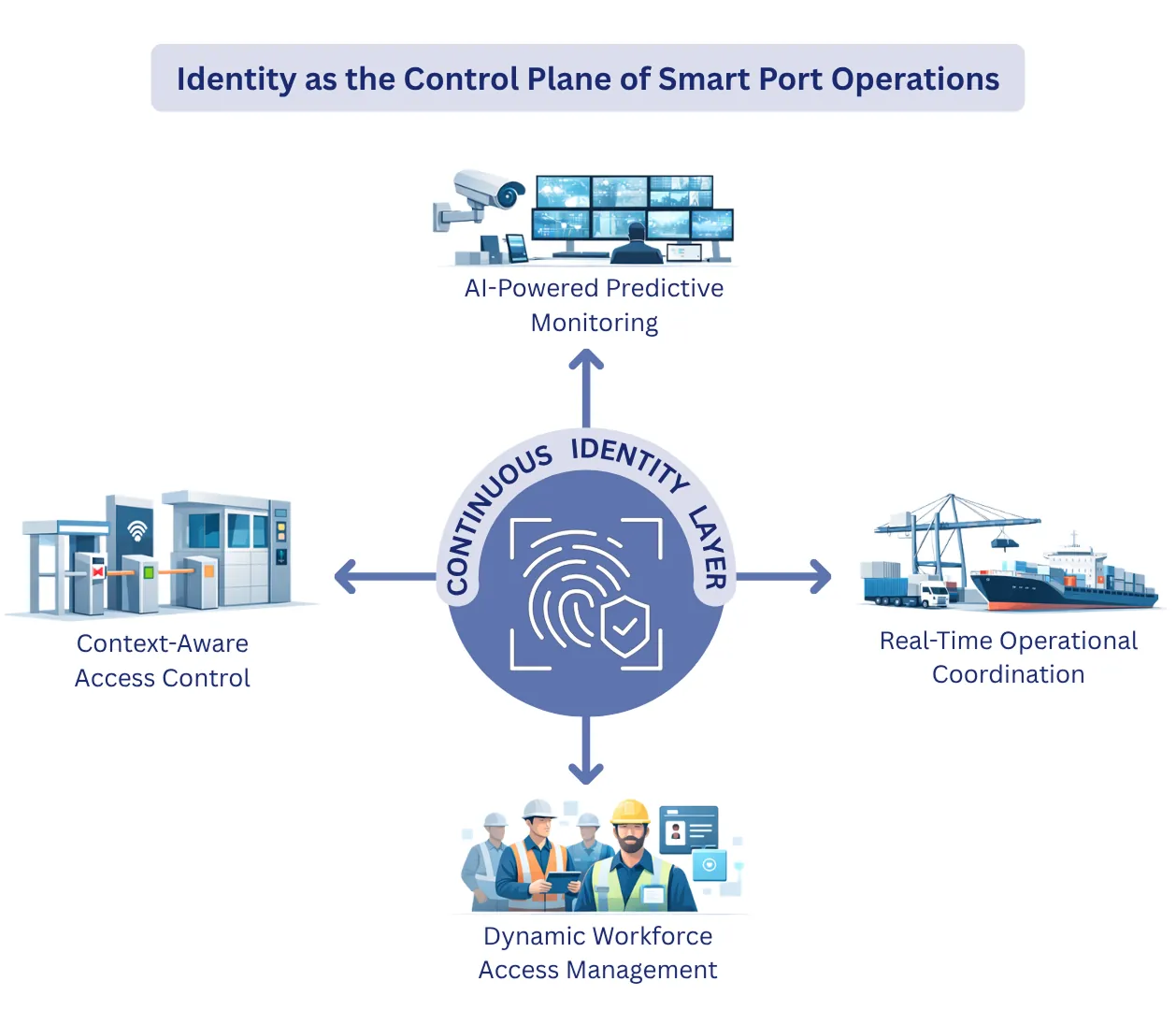
At the scale envisioned by the Maritime Amrit Kaal Vision 2047, Identity is the only consistent reference point. A coordinated architecture centers all operational layers around a persistent, biometric identity anchor. This places the human at the center of the logic, ensuring permissions follow the person, not just a plastic credential.
Layer 1: Identity as the Control Plane
Identity moves from a one-time gate check to a continuous reference. Every interaction links back to a verified individual, creating a single source of truth and removing the risks associated with transferable credentials.
Layer 2: Context-Aware Movement
Access control shifts from static validation to dynamic authorization. Permissions align with live job orders and terminal zones. Access is granted only when specific conditions are met and revoked automatically when those conditions change.
Layer 3: Active Monitoring
Surveillance transitions into active operational awareness. AI-enabled vision identifies anomalies as they happen. Monitoring no longer just records history; it actively supports safety and flow by alerting operators to bottlenecks before they stop work.
Layer 4: System Alignment
Identity, access, and monitoring function as a unified structure. A shift completion or a permit expiration updates the entire port's security logic instantly, maintaining integrity without human intervention.
Operational Impact: Measurable Performance Gains
A coordinated approach directly influences the bottom line and improves national logistics rankings:
- Optimized Throughput: Faster validation reduces gate congestion and slashes idle time for transport vehicles.
- Reduced Vessel Turnaround Time (VTT): Operational advancements in Indian ports have already reduced average VTT from 93 hours to 48 hours (Source: PIB India), an improvement of approximately 48% in efficiency. Coordination is the key to pushing these numbers even lower.
- Autonomous Resilience: Systems remain responsive during peak loads, reducing dependency on manual oversight and minimizing human error.
Conclusion
As ports scale toward 10,000 MTPA capacity targets for 2047, infrastructure alone will not define success. The ability of systems to coordinate in real time will determine which ports lead the global market. Transitioning toward identity-centric architectures is the next logical step in port design. By focusing on coordination over mere integration, ports can achieve the resilience and speed required for modern global trade.